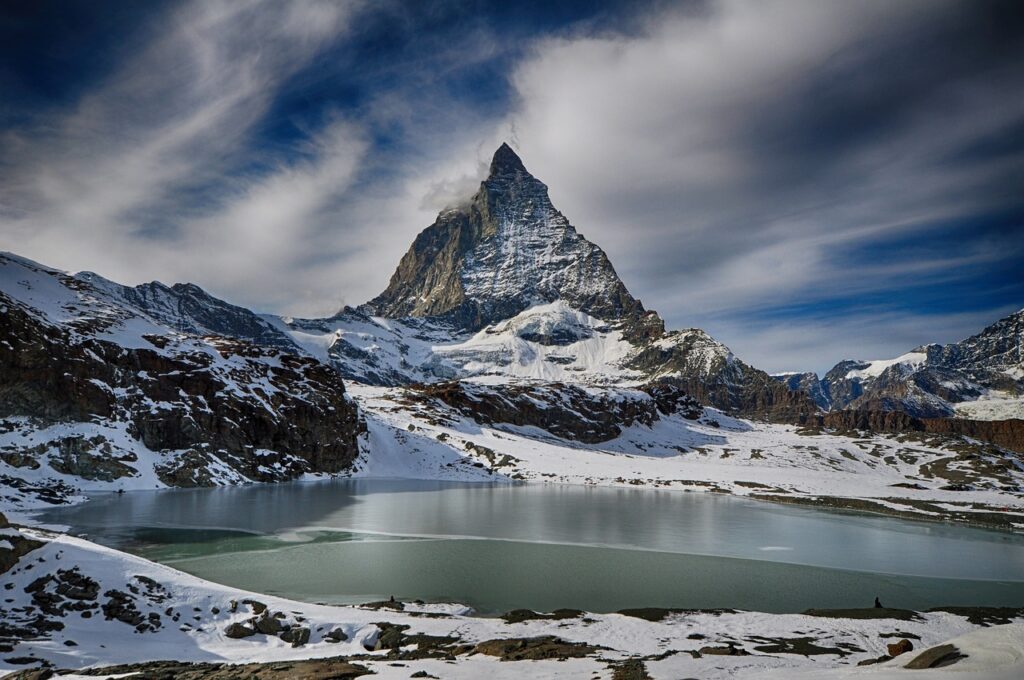
Matterhorn
The Hiker’s Guide to the Matterhorn: Touching the Sky in Zermatt
The Matterhorn is the most recognizable mountain on Earth. Its jagged, four-sided pyramid isn’t just a peak; it is a monument to the golden age of mountaineering. While the summit is reserved for those with ice axes, crampons, and nerves of steel, the mountain is surprisingly accessible to the dedicated hiker.
To truly „experience“ the Matterhorn as a hiker, you don’t look at it from a hotel balcony in Zermatt—you hike to the Hörnlihütte. This is the literal basecamp of the giants.
1. The Route: The Hörnli Ridge Approach
This is the „pilgrimage“ for hikers. You are following the lower section of the Northeast Ridge—the same path Edward Whymper took during the first, tragic ascent in 1865.
- Starting Point: Schwarzsee (2583m), reached via the Matterhorn Express gondola from Zermatt.
- Destination: Hörnlihütte (3260).
- Distance: Approx. 8,5km round trip.
- Elevation Gain: 700m of vertical climbing.
- Difficulty: T3+ (Challenging Hike). This is not a casual stroll. Expect steep switchbacks, metal gratings over drops, and thin air.
The Ascent
The trail begins at the emerald waters of Schwarzsee. For the first 30 minutes, the path is wide and deceptively gentle. However, once you pass the initial plateau, the mountain reveals its teeth.
The trail transforms into a series of steep, rocky zig-zags carved directly into the shoulder of the mountain. You’ll cross the „Matterhorn Glacier“ moraine, where the terrain is gray, lunar, and raw. As you climb higher, the path becomes narrower, and metal walkways are bolted into the cliffside to help you navigate the vertical sections.
The Arrival: Hörnlihütte
When you reach the hut, you are standing at the threshold of the heavens. The Hörnlihütte was completely rebuilt in 2015 and serves as the starting point for summit attempts.
- The Vibe: At 11:00 AM, the hut is buzzing with hikers having lunch. But if you look at the climbers coming down from the summit, you’ll see the „Matterhorn Face“—a mix of exhaustion and pure adrenaline.
- The „Hörnli Step“: Just past the hut is a fixed rope where the actual climbing begins. As a hiker, this is your turnaround point. Standing here, looking up at the 1200m wall of rock above you, is a humbling experience.
2. The „Mirror“ Experience: Riffelsee
If the Hörnlihütte is about the power of the mountain, Riffelsee is about its beauty.
- The Route: Take the Gornergrat Cog Railway to Rotenboden.
- The Hike: A short, 10-minute walk down to the lake.
- The View: On a windless day, the Matterhorn reflects perfectly in the alpine water. It is the most famous photo-op in Switzerland.
- The Extended Trail: Continue hiking down from Riffelsee to Riffelberg. You’ll walk through high-alpine meadows where you’re likely to spot Blacknose Sheep—the fluffy, spiral-horned mascots of the Valais region.
3. Essential Gear & Preparation
The Matterhorn creates its own weather system. You can be in a T-shirt at Schwarzsee and in a blizzard at the Hörnlihütte 90 minutes later.
- Footwear: Sturdy, high-cut trekking boots with a Vibram sole. The rock is sharp and loose (scree).
- Clothing: The „Three-Layer Rule“ is mandatory. A moisture-wicking base, a fleece mid-layer, and a Gore-Tex outer shell.
- Sun Protection: The UV rays are brutal. Bring Category 3 or 4 sunglasses and high-altitude sunblock.
- Hydration: There are no water taps on the ridge. Carry at least 2l of water.
4. Logistics: When to Go
- The Window: The hiking season for the Hörnlihütte is short: July to September. Before July, the trail is often buried in snow and requires crampons.
- The „Zermatt Rule“: Zermatt is a car-free village. You must park your car in the nearby town of Tasch and take the shuttle train into the village.
- The Cost: The cable cars and trains in Zermatt are expensive (. If you have a Swiss Travel Pass or Half-Fare Card, use it!
5. Safety Warning
The Matterhorn is a „living“ mountain. Rockfalls are common, especially in the afternoon as the permafrost thaws. Always stay on the marked white-red-white alpine trails. If you feel dizzy (altitude sickness), descend immediately. The air at $3,260\text{m}$ contains significantly less oxygen than at sea level.